When buyers order an overhead crane, they usually focus on rated capacity and span. A third factor often determines service life and total cost: the duty cycle and mechanism working class.
Two 10-ton cranes can look similar yet be designed for very different operating patterns. This guide explains how FEM and ISO classes help engineers match the crane to real production demands.
The real-world difference:
- Under-specifying duty class causes overheating, brake wear, rope fatigue, and downtime.
- Over-specifying duty class adds cost for capacity the facility will not use.

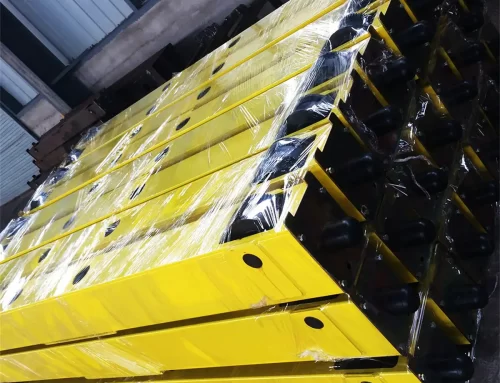
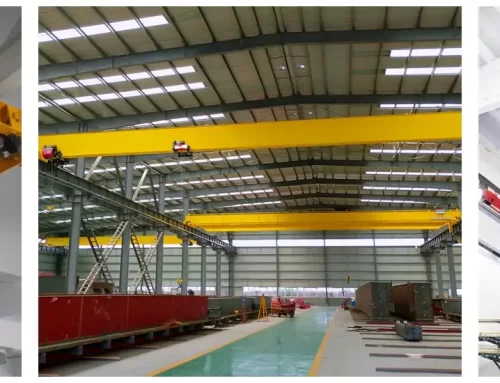
Heavy-duty double girder bridge crane engineered for continuous material handling.
How Duty Class Is Determined: ISO 4301 and FEM 9.511
Duty group is determined from state of loading and class of utilization: average load spectrum and cumulative motor running hours.
Load Spectrum
| Load Spectrum | Cubic Factor | Typical Pattern | Examples |
|---|---|---|---|
| L1 Light | k ≤ 0.50 | Light hook loads, rated load rarely | Maintenance bays |
| L2 Moderate | 0.50 < k ≤ 0.63 | 30–50% loads, occasional full load | Fabrication shops |
| L3 Heavy | 0.63 < k ≤ 0.80 | Frequent high loads | Steel warehouses |
| L4 Very Heavy | 0.80 < k ≤ 1.00 | Near-rated capacity continuously | Foundry ladle cranes |
Daily Operating Time
- T2: 0.5–1 hour/day for infrequent maintenance lifting.
- T4: 2–4 hours/day for intermittent production.
- T6: 8–16 hours/day for continuous multi-shift operations.
- T8: more than 16 hours/day for ports, scrap yards, and mills.
ISO/FEM Working Classes M3 to M8
| Class | FEM Equivalent | Typical Use |
|---|---|---|
| M3 | 1Bm | Light maintenance |
| M4 | 1Am | Light fabrication |
| M5 | 2m | General production |
| M6 | 3m | Heavy manufacturing and precast |
| M7–M8 | 4m–5m | Steel mills, foundries, and grab cranes |
What Changes as Duty Class Increases?
- Higher classes use larger motors, higher ED ratings, forced cooling, and more starts per hour.
- Gearboxes use wider, hardened gears and thermal-dissipating oil systems.
- Larger drum-to-rope ratios reduce bending stress and extend rope life.
- Bridge structures receive reinforced weld details and fatigue calculations.
Practical Class Selection
- M3/M4: Maintenance bays and small machine shops.
- M5: General manufacturing and medium-throughput warehouses.
- M6: Heavy machinery, steel coil logistics, and precast yards.
- M7/M8: Continuous foundry, steel mill, and grab-crane duty.
For standards comparison, read our CMAA vs FEM and ISO guide or our top running vs underhung guide.
Need Custom Crane Sizing or Engineering Calculations?
Our application engineering team provides free runway wheel load calculations, FEM/ISO duty class matching, and custom CAD drawings for your facility.
Frequently Asked Questions
Can hoist and travel mechanisms have different duty classes?
Yes. The hoist may require M6 while bridge travel can use M5 if travel is less frequent.
What is the equivalent CMAA class for M5?
ISO M5/FEM 2m generally aligns with moderate-service CMAA Class C.
How does VFD affect duty life?
VFD acceleration reduces shock loads and can extend gearbox, brake, and wheel-flange fatigue life.